
When an older parent, partner or relative suddenly seems confused, it can be frightening. They may not know where they are, struggle to follow a conversation, behave very differently from usual or even see or hear things that are not there.
Families sometimes assume that this is dementia, especially when the person is older or already has memory problems. But sudden confusion is different from the gradual changes usually associated with dementia and can be a sign of delirium or another serious medical problem.
The most important thing to know is simple:
If someone suddenly becomes confused, get medical help immediately. The NHS advises calling 999 or going to A&E.
Many causes of sudden confusion need prompt assessment and treatment, and some can be life-threatening. Do not wait to see whether the confusion improves on its own.
This guide explains the difference between delirium and dementia, the signs families should watch for and what to do when an older person's mental state changes unexpectedly.
Delirium vs Dementia: The Key Difference
Delirium and dementia can both cause confusion, memory difficulties and changes in behaviour, but they are not the same condition.
Delirium is usually a sudden change from a person's normal mental state. It can develop over hours or a few days and often changes during the course of the day.
Dementia is a syndrome caused by diseases affecting the brain. In most cases, symptoms develop progressively over a much longer period and gradually affect memory, thinking, communication, judgement and the ability to manage everyday life.
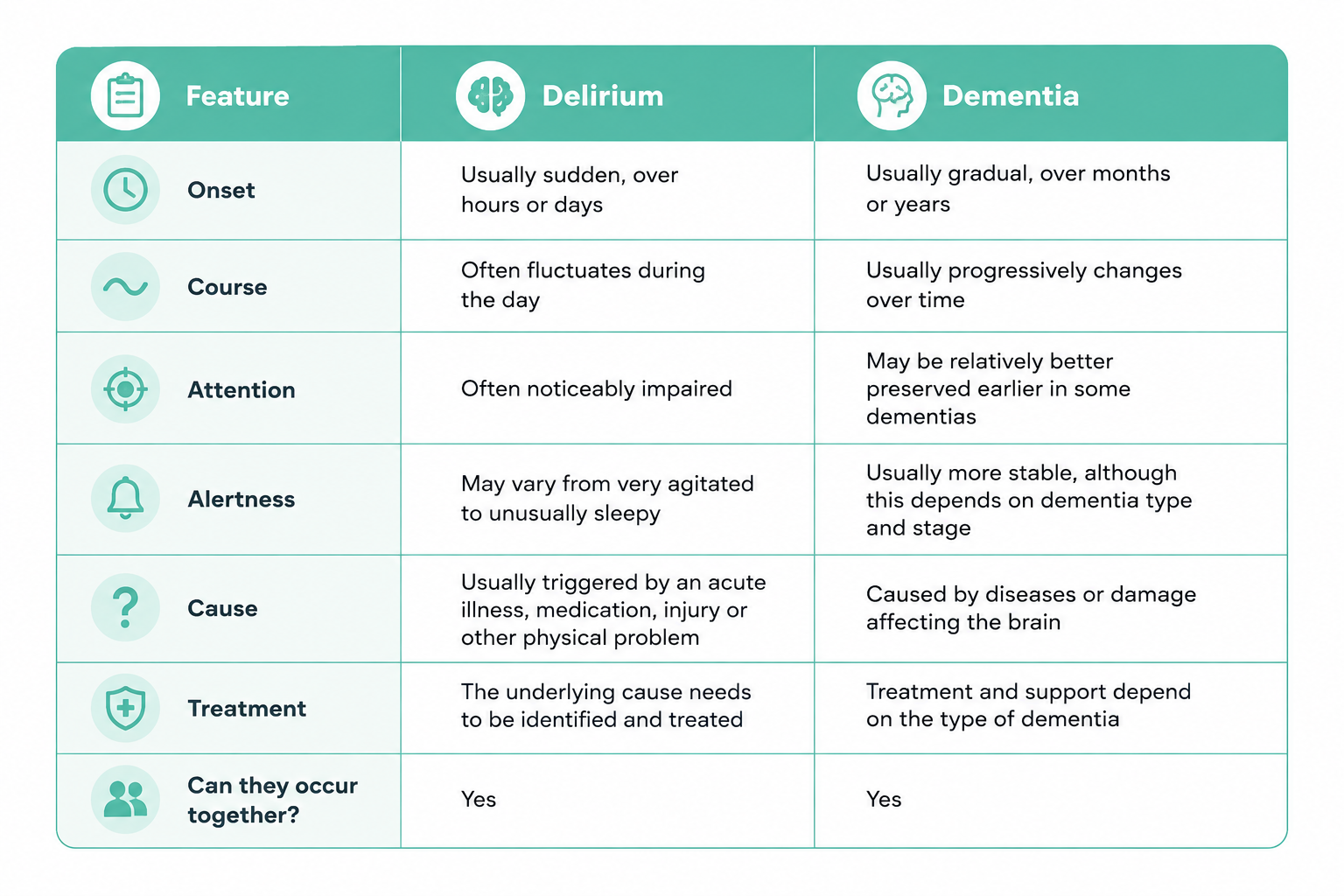
This table is a general guide, not a diagnostic tool.
There are important exceptions. For example, vascular dementia can sometimes begin more abruptly, particularly around a stroke, and dementia with Lewy bodies can cause fluctuating levels of confusion and alertness. Any new or sudden change from someone's normal state should therefore be medically assessed rather than diagnosed at home.
What Is Delirium?
Delirium is an acute disturbance in the way the brain is functioning.
A person may suddenly have difficulty paying attention, thinking clearly, understanding what is happening around them or staying properly alert. Their symptoms may change considerably over the course of a day.
Someone may appear almost like themselves at one point and be much more confused several hours later.
Delirium is particularly common in older adults and people who already have dementia, frailty, several medical conditions or serious illness. Dementia itself increases a person's vulnerability to developing delirium.
Delirium does not always look like agitation
One reason delirium can be missed is that not everyone becomes restless or distressed.
Healthcare professionals generally describe three patterns.
Hyperactive delirium
The person may become:
- restless or agitated
- unusually anxious or frightened
- irritable or aggressive
- unable to settle
- suspicious of people around them
- affected by hallucinations
This is often the type families notice most quickly.
Hypoactive delirium
The person may instead become:
- unusually sleepy
- quiet or withdrawn
- slow to respond
- less interested in eating or drinking
- less communicative
- much less active than normal
Hypoactive delirium can be particularly easy to overlook because the person is not causing disruption. A family member may simply think they are tired or "not quite themselves".
Mixed delirium
Some people move between the two patterns—for example, being restless and distressed at one point and unusually sleepy or withdrawn later.
What Does Sudden Confusion Look Like?
A person experiencing delirium may:
- not know where they are
- struggle to remember what has just happened
- have difficulty following a conversation
- lose concentration very quickly
- speak in a way that is difficult to follow
- behave very differently from normal
- become frightened or suspicious
- see or hear things that are not there
- become unusually restless
- become unexpectedly sleepy or withdrawn
- experience changes in their sleep-wake pattern
The NHS suggests that if you are unsure whether someone is confused, simple information such as their name, age and today's date may help indicate whether something is wrong.
However, once it is clear that the person is confused, do not repeatedly test or question them. The priority is reassurance and medical assessment.
What Can Cause Delirium in an Older Person?
Delirium is not usually a disease in itself. It is often the brain's response to another health problem.
Possible causes include:
- infections
- stroke or transient ischaemic attack (TIA)
- low blood sugar, particularly in someone with diabetes
- head injury
- some prescription medicines
- medication changes or side effects
- dehydration
- pain
- constipation
- difficulty passing urine
- low oxygen levels
- surgery or anaesthesia
- seizures
- alcohol poisoning or alcohol withdrawal
- serious heart or lung problems
- disturbances in salts, glucose or other body chemistry
Sometimes more than one problem is contributing at the same time, particularly in frail older people with several health conditions.
Does a UTI cause confusion in older people?
Urinary tract infections can be associated with delirium in older adults, and the NHS lists infection—including UTI—as a possible cause of sudden confusion.
However, families should avoid assuming that every episode of confusion is "just another UTI".
Older adults can have bacteria in their urine without a symptomatic urinary infection, and confusion may have another cause or several causes at once. A proper clinical assessment is therefore important rather than trying to identify the cause from symptoms alone.
What Is Dementia?
Dementia is not a single disease.
It is a syndrome—a group of symptoms caused by conditions that affect the brain. Alzheimer's disease is the most common cause, but other causes include vascular dementia, dementia with Lewy bodies and frontotemporal dementia.
Dementia can affect:
- memory
- thinking speed
- concentration
- language and communication
- understanding
- judgement
- mood and behaviour
- the ability to carry out everyday activities
Unlike delirium, these difficulties usually develop progressively rather than appearing as a completely new change over a few hours.
Someone might gradually begin forgetting recent conversations, becoming confused when managing money, struggling to find words, finding familiar tasks more difficult or becoming increasingly disorientated.
The NHS stresses that dementia is not a normal part of ageing.
Can Someone Have Dementia and Delirium at the Same Time?
Yes—and this is one of the most important points for families to understand.
A person who already lives with dementia can still develop delirium.
In fact, dementia is an important risk factor for delirium. The person's usual memory problems do not protect them from infections, dehydration, medication problems, pain, stroke or other acute illnesses.
This means a sudden deterioration should never automatically be attributed to dementia.
A useful question is:
"Is this person's behaviour or mental state significantly different from what is normal for them?"
For example, someone with dementia may normally forget the day of the week but still recognise their daughter, eat breakfast independently and have a conversation.
If they suddenly become extremely sleepy, cannot concentrate, do not recognise familiar people or begin hallucinating when this is not usual for them, that is a change from their baseline and needs medical attention.
Family members and regular carers are often particularly valuable in recognising this because they know what is normal for the person.
What Should You Do If an Older Person Suddenly Becomes Confused?
1. Call 999 or go to A&E
The NHS advice is clear: sudden confusion requires immediate medical help.
Some possible causes—including stroke, serious infection, very low blood sugar, head injury or severe heart and lung problems—can require urgent treatment.
Do not drive the confused person to A&E yourself if this would be unsafe. Follow the advice of the emergency services.
2. Stay with the person
Someone who is confused may feel frightened because their surroundings suddenly do not make sense.
Stay nearby if it is safe to do so.
Tell them calmly:
- who you are
- where they are
- that you are staying with them
- that help is coming
Use short, simple sentences.
3. Do not overwhelm them with questions
Repeatedly asking:
"Do you know who I am?"
"What day is it?"
"Where are you?"
may increase anxiety once it is already obvious that something is wrong.
Keep communication calm and simple instead.
4. Gather their medication information
If possible, have their medicines or an up-to-date medication list available for the healthcare team.
Medication changes, side effects and interactions can contribute to delirium, and an accurate medication history can be extremely useful during assessment.
5. Think about what changed
While waiting for medical help, it can be useful to note:
- when the confusion started
- what the person is normally like
- whether symptoms came on suddenly or gradually
- any recent illness
- fever, cough or urinary symptoms
- recent falls or head injuries
- pain
- changes in eating or drinking
- constipation or difficulty passing urine
- recent hospital treatment or surgery
- new medicines or recent medication changes
- diabetes
- alcohol use or possible withdrawal
You do not need to work out the diagnosis yourself. This information simply helps healthcare professionals understand what has changed.
How Is Delirium Diagnosed?
There is no single home test that can tell a family whether someone has delirium.
Healthcare professionals consider the person's symptoms, how quickly they developed, changes in attention and alertness, medical history, medicines and information from people who know them.
Validated clinical screening tools such as the 4AT may be used to help identify possible delirium, particularly in hospitals and urgent-care settings.
The medical team then looks for the underlying cause. Depending on the circumstances, this may involve examination, blood tests, urine assessment, oxygen measurements, medication review, imaging or other investigations.
The important point is that treating delirium means looking beyond the confusion itself and identifying why the brain's function has suddenly changed.
Does Delirium Go Away?
Delirium is often temporary, particularly when the underlying problem can be identified and treated.
However, recovery is not always immediate.
Some people improve within hours or days. Others may remain affected for weeks, and recovery can sometimes take considerably longer—particularly in frail older adults or people already living with dementia.
A person may also seem better one day and more confused again the next.
For this reason, families should not assume that someone is fully recovered simply because they have had a good morning or appear more settled.
Delirium can be a significant health event and the person may need extra help during and after recovery.
What Happens After the Immediate Medical Problem Has Been Treated?
For many families, getting through the emergency is only the first part of the situation.
An older person who was previously managing reasonably well may return home from hospital feeling weaker, more anxious or less confident. They may temporarily need more support with:
- getting washed and dressed
- preparing and eating meals
- drinking enough
- mobility
- toileting
- medication routines
- attending appointments
- maintaining a safe daily routine
- reassurance and companionship
- monitoring for further changes from their usual condition
This is where good communication between the person, family, healthcare professionals and care team becomes especially important.
Supporting Someone After Delirium at Home
Once a healthcare professional has assessed the person and it is safe for them to be at home, familiar surroundings and predictable routines can be reassuring.
Depending on the person's individual care plan, helpful support may include:
Maintaining a familiar routine
Regular meals, sleep times and familiar daily activities can make the environment easier to understand.
Supporting hydration and nutrition
Poor intake can be both a contributing problem and a consequence of illness. Any specific fluid or dietary restrictions from healthcare professionals should always be followed.
Making sure glasses and hearing aids are available
Difficulty seeing or hearing can make an already confusing environment harder to interpret.
Providing calm communication
Speak clearly, give the person time to respond and explain what is happening before helping them with a task.
Observing changes
Family members and regular carers can pay attention to changes in:
- alertness
- communication
- appetite
- drinking
- mobility
- sleep
- toileting
- mood
- behaviour
The role of a carer is not to diagnose delirium, but consistent carers can sometimes notice that something has changed and help ensure concerns are escalated appropriately.
Home Care Support for Older People and Families in Haringey
After the medical cause of sudden confusion has been assessed and treated, an older person may still need additional support at home—particularly if they are recovering from delirium or already living with dementia, frailty or another long-term condition.
At My Homecare Haringey, we can help make everyday life safer and easier by supporting personal care, meals and hydration, medication routines, mobility, companionship and familiar daily routines.
Consistent carers can be especially reassuring for someone experiencing confusion. By getting to know the person's normal behaviour, preferences and routines, carers can also notice meaningful changes and share concerns with families or healthcare professionals when appropriate.
Our aim is to help each person remain as safe, comfortable and independent as possible in their own home, while giving families confidence that their loved one is receiving dependable, compassionate support.
For families who need more ongoing help, our Domiciliary Care in Haringey, Personal Care, Respite Care and dementia-related support can be tailored around the individual's needs.
Frequently Asked Questions
Is sudden confusion always delirium?
No. Sudden confusion can have several possible causes, including infection, stroke, low blood sugar, head injury, medication effects, seizures and serious heart or lung problems.
Delirium is one possible explanation, but the cause needs to be assessed by healthcare professionals.
Is delirium the same as dementia?
No.
Delirium usually develops suddenly, often over hours or days, and is commonly associated with an acute medical problem.
Dementia usually develops gradually and causes ongoing changes in memory, thinking and everyday functioning.
Can someone with dementia develop delirium?
Yes. In fact, people living with dementia are at increased risk of developing delirium.
A sudden change in someone's normal behaviour, attention, alertness or communication should not automatically be assumed to be part of their dementia.
Can dementia suddenly get worse?
Someone with dementia may appear to deteriorate very quickly if another illness or delirium develops.
A sudden or significant change should therefore be medically assessed rather than assumed to be normal progression of dementia.
Can delirium cause hallucinations?
Yes. Some people experiencing delirium may see or hear things that are not there.
However, hallucinations can also occur in some forms of dementia, so this symptom alone cannot distinguish delirium from dementia.
How long does delirium last?
Recovery varies considerably.
Some people improve within hours or days once the underlying cause is treated, while others may remain affected for weeks or longer. Recovery can take longer in frail older adults and people who already have dementia.
Should I call 999 if an older person suddenly becomes confused?
Yes. NHS guidance advises calling 999 or going to A&E if someone suddenly becomes confused.
Sudden confusion can sometimes be caused by a serious medical condition that requires urgent assessment.
Can someone recover from delirium and still need care at home?
Yes. Even after the underlying medical problem has been treated, some older people may temporarily be weaker, less confident or need more help with everyday activities.
Home care can support daily routines, personal care, meals, mobility and companionship while the person recovers.