

A person with Parkinson’s may be walking across the room normally and then suddenly stop at a doorway.
They know where they want to go. They are trying to move. But their feet seem unable to take the next step.
People with Parkinson’s often describe this sensation as feeling as though their feet have been “glued to the floor.” This is known as freezing.
At other times, movement may become difficult because Parkinson’s medication is no longer controlling symptoms as well as it was earlier in the day. This is known as an “off” period.
The two problems can look similar, but they are not the same—and understanding the difference matters because they may need different approaches. Parkinson’s UK specifically advises that freezing and “on/off” changes should be treated as separate problems by the person's specialist or Parkinson’s nurse.
For families, the goal is not to force someone to move faster. It is to understand what makes movement harder, what can help the person restart safely, and when a change needs professional review.
What Does Freezing in Parkinson’s Actually Mean?
Freezing is a temporary interruption in movement.
The person may want to step forward but suddenly be unable to do so. Their feet may remain still, they may take several extremely small steps, or their legs may tremble on the spot.
An episode can last only a few seconds, although sometimes it lasts 30 seconds or longer.
Freezing most commonly affects walking and is particularly likely to happen:
- when starting to walk
- when turning
- when going through a doorway
- in narrow spaces
- when the flooring changes
- in busy or crowded environments
- when the person is distracted
- when they are rushing.
Parkinson’s UK reports that more than half of people with Parkinson’s may experience freezing, although it is more common in advanced Parkinson’s.
Families looking for wider information about day-to-day support may also find our guide to supporting seniors living with Parkinson’s useful.
Why Can a Doorway Suddenly Become Difficult?
This is one of the more unusual features of Parkinson’s freezing.
Someone may walk relatively well across a room but suddenly stop at the doorway. Another person may manage stairs surprisingly well but freeze once they return to a flat floor.
This does not mean the person is choosing when they can and cannot walk.
Walking is normally highly automatic. We usually think about where we are going rather than consciously controlling every step.
With Parkinson’s, walking can require more conscious attention. When the brain also has to deal with a doorway, a turn, another person talking, a change in floor pattern or a crowded environment, continuing the normal rhythm of walking can become more difficult.
This helps explain another important pattern:
The more someone is rushed, distracted or anxious, the harder freezing may become.
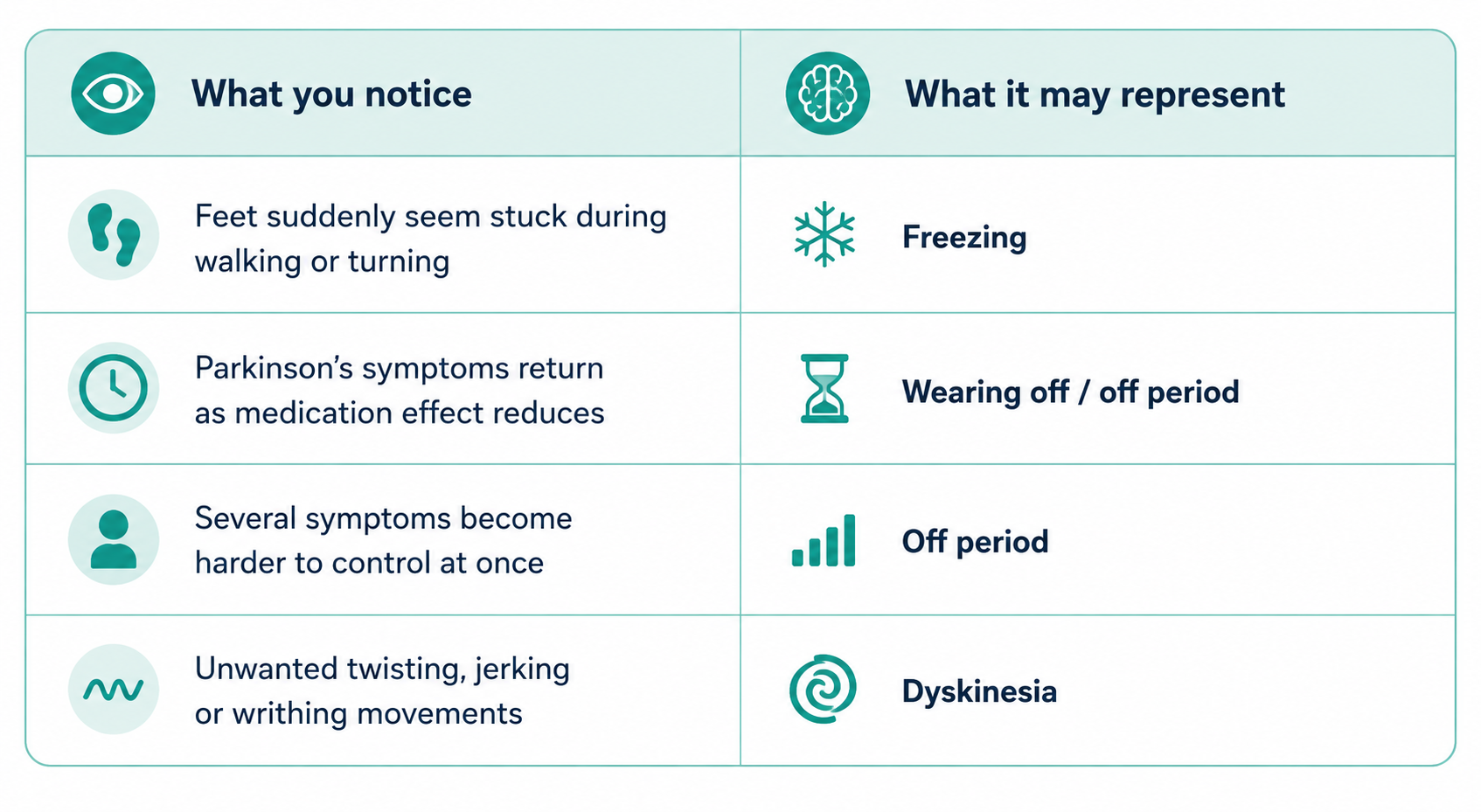
Freezing Is Not the Same as an “Off” Period
This distinction is particularly important.
Freezing
Freezing usually interrupts a particular movement.
For example, someone may be unable to take the next step but still be able to move their arms, speak or reach for something.
An “off” period
An “off” period happens when Parkinson’s symptoms return or become harder to manage as medication is providing less symptom control.
During an off period, the person may experience increased:
- stiffness
- slowness
- tremor
- difficulty walking
- difficulty standing up
- problems carrying out everyday tasks.
Off periods can also involve symptoms that are not obviously related to movement, including anxiety, sleepiness, low mood or pain.
“Wearing off”
“Wearing off” usually means symptoms begin returning before the next medication dose is due.
Dyskinesia
There is another movement change families sometimes confuse with freezing.
Dyskinesia means involuntary movements such as twisting, jerking or writhing movements. It is therefore very different from being unable to initiate a movement.
A useful simplified comparison is:
Freezing Can Happen During Both “On” and “Off” Periods
It would be easy to assume that freezing simply means Parkinson’s medication has worn off.
The reality is more complicated.
Freezing can occur during “off” periods, when medication is controlling symptoms less effectively. But it can also happen while someone is otherwise “on” and their medication appears to be working.
Parkinson’s UK notes that freezing tends to be more common during an off period and episodes may last longer, but freezing and off periods remain separate problems.
This distinction matters because increasing medication is not automatically the answer to every freezing episode.
Medication decisions need to be made by the person's Parkinson’s specialist or Parkinson’s nurse.
What Should Someone Do When Their Feet Freeze?
The natural reaction is often to try harder to move.
That can sometimes make the situation more stressful.
Instead, Parkinson’s physiotherapy guidance commonly uses techniques that interrupt the unsuccessful movement attempt and help the person prepare to start again.
One useful approach described by Parkinson’s UK is:
STOP → THINK → PLAN → DO.
In practical terms:
1. Stop trying to force the next step
Take a moment.
Trying to rush forward while the feet remain fixed may move the upper body ahead of the feet and increase the risk of losing balance.
2. Take a breath
Anxiety can make freezing worse.
Pausing gives the person time to regain their balance and focus on the next movement.
3. Decide which foot will move first
Instead of thinking about the entire journey, concentrate on one step.
4. Use a familiar movement strategy
The person may have been taught a particular technique by their physiotherapist, such as shifting their weight, counting or using a visual cue.
The aim is to restart the rhythm of movement, not to physically force the person forward.
Weight Shifting Can Help Some People Restart
Normal walking involves transferring body weight onto one leg so the opposite leg can step.
During freezing, deliberately recreating this movement may help some people.
Parkinson’s UK suggests that a person may gently move their weight onto one leg and then step forward with the opposite foot.
A rhythm can be added:
“One, two, three, step.”
or
“Ready, steady, go.”
Some people find gentle side-to-side weight shifting helpful before attempting the first step.
However, balance differs between individuals. Someone who is unsteady or at high risk of falling should learn these techniques with a Parkinson’s physiotherapist rather than practising difficult movements without professional guidance.
Rhythm Can Sometimes Unlock Movement
One fascinating feature of Parkinson’s freezing is that an external rhythm can sometimes help where simply thinking “walk” does not.
This is known as cueing.
A cue gives the brain another signal around which to organise movement.
Examples include:
- counting “one, two, one, two”
- saying “left, right, left, right”
- saying a simple word such as “step”
- humming a familiar rhythm
- walking to a beat
- using a metronome.
Visual cues can also work for some people. For example, a line on the floor may provide a target to step over.
But there is an important point families should know:
There is no single cue that works for everyone.
A technique that is effective in the kitchen may not work in a busy shopping centre. Strategies can also change as Parkinson’s progresses.
A Parkinson’s physiotherapist can help identify and practise cues that suit the individual.
What Should a Family Member Do During a Freezing Episode?
Watching someone suddenly become unable to move can be unsettling, particularly near stairs, traffic or in a crowded place.
The most helpful response is usually calm and simple.
Give the person time
Avoid repeatedly saying:
“Come on.”
“Just move.”
“Hurry up.”
The person already intends to move. Freezing is a Parkinson’s movement symptom, not a lack of effort.
Reduce distractions
If several people are talking, stop the conversation for a moment.
Allow the person to focus on movement.
Ask which cue helps
If the person has practised a strategy, use that strategy.
For example:
“Ready, steady, step.”
may be more useful than giving several instructions at once.
Help with balance where appropriate
Parkinson’s UK notes that a family member or friend can sometimes support the person's balance by holding their arm while they concentrate on moving again.
The exact way someone should be physically supported depends on their mobility and care plan.
If you regularly need to physically assist someone to stand, walk or transfer, ask a physiotherapist, occupational therapist or other appropriate professional to demonstrate safe moving techniques. The NHS warns that incorrect lifting can injure both the person being supported and the carer.
Never Reach Too Far for Furniture When the Feet Are Frozen
This is a small but important safety detail.
If someone's feet are fixed to the floor but their upper body can still move, they may instinctively reach towards a wall, table or chair.
If the object is too far away, their body can move forward while their feet stay behind.
That can result in a fall.
Parkinson’s UK specifically warns about reaching for support that is too far away during freezing.
A stable support that is already within easy reach can be useful, but stretching towards distant furniture is different.
Turning Is a Particularly Important Moment
Turning is one of the most common triggers for freezing and falls.
Someone may walk reasonably well in a straight line but struggle when changing direction.
Rather than quickly pivoting on one foot, Parkinson’s UK recommends slowing down and using several steps to make a wider, semicircular turn. One suggestion is to imagine the feet moving around the numbers on a clock face.
This can feel slower, but that is exactly the point.
Safer movement is more important than fast movement.
Families should therefore avoid creating unnecessary urgency around getting to the door, answering a phone or reaching the bathroom.
Walking and Talking Can Be Surprisingly Difficult
For most people, walking while having a conversation feels effortless.
For someone experiencing Parkinson’s freezing, doing two things at once can place additional demands on attention.
Parkinson’s UK recommends reducing distractions and, where necessary, stopping walking while talking.
This can apply to many situations:
- answering questions while walking
- carrying something while moving
- looking for an item while walking
- navigating a crowded room
- using a phone while moving.
Families can make movement easier by allowing the person to complete one task before beginning another.
Look for the Person's Individual “Freezing Zones”
Instead of treating freezing as random, look for patterns.
Common trouble spots include:
- the bedroom doorway
- narrow corridors
- the route into the bathroom
- the kitchen entrance
- turning beside the bed
- moving around furniture
- changing from carpet to hard flooring.
Freezing can be very difficult for a specialist to observe because it may not happen during a short clinic appointment.
Parkinson’s UK therefore recommends keeping notes about:
- when freezing happened
- where it happened
- what the person was doing
- what helped them start moving again.
This simple record can provide much more useful information than telling the Parkinson’s nurse:
“His walking is getting worse.”
For example:
“He freezes most mornings when turning through the bathroom doorway, especially before his next medication dose.”
That gives the healthcare team a pattern they can investigate.
Home Design Can Influence Freezing
Reducing falls in Parkinson’s is not simply about removing obvious trip hazards.
The visual environment itself can sometimes influence freezing.
Parkinson’s UK identifies changes in flooring, patterned surfaces, narrow areas, poor lighting and clutter as potential difficulties for some people.
Useful changes may include:
- keeping regular walking routes clear
- providing good lighting
- reducing unnecessary clutter
- allowing enough room to make wider turns
- removing unstable rugs or mats
- ensuring furniture does not create unnecessarily narrow pathways
- keeping commonly used items easy to reach.
Our room-by-room guide to preventing falls at home provides more practical ideas for reducing hazards while protecting independence.
What about lines on the floor?
Some people with Parkinson’s use contrasting floor strips as visual stepping cues in places where they regularly freeze.
But visual patterns can help one person and interfere with movement for another.
Floor markings should therefore be individualised, securely fixed so they do not themselves become a trip hazard, and ideally discussed with a physiotherapist or Parkinson’s nurse.
A Walking Frame Is Not Automatically the Solution
When someone's walking becomes less stable, families understandably consider buying a walking frame.
But Parkinson’s movement problems are unusual.
Parkinson’s UK specifically warns that the wrong walking aid can make freezing worse and recommends assessment by a physiotherapist.
The right equipment depends on:
- balance
- posture
- strength
- freezing pattern
- ability to turn
- home environment
- how the person uses the aid.
For the same reason, specialist equipment such as laser-cueing walking aids should not be viewed as a universal solution.
They can help some people by projecting a visual line to step over, but not everyone responds in the same way.
Why Medication Timing Matters
For many people with Parkinson’s, medication timing is much more precise than taking an ordinary tablet “sometime in the morning”.
If Parkinson’s medicine is taken late or missed, symptoms can become more difficult to control and freezing may become more likely in some individuals.
Families can help by making sure the person's prescribed medication schedule is followed accurately.
Our article on how professional caregivers in Haringey support medication management and daily routines explains this aspect of home support in more detail.
However:
Do not change the dose, frequency or timing of Parkinson’s medication yourself.
NICE specifically recommends seeking advice from a healthcare professional with specialist expertise in Parkinson’s before modifying treatment when motor fluctuations such as wearing off develop.
And Parkinson’s medication should not simply be stopped suddenly. For example, the NHS warns that abruptly stopping co-beneldopa can cause serious withdrawal symptoms including severe stiffness, fever and confusion.
Do Not Remove Protein From the Diet Because of “Off” Periods
This is another area where families can receive confusing advice.
Protein can affect how levodopa works for some people, and NICE advises that a protein redistribution diet may be discussed with people taking levodopa who experience motor fluctuations.
That does not mean removing protein from the diet.
NICE explicitly advises against reducing the person's total daily protein intake.
If food seems to affect medication response, speak with the Parkinson’s specialist, nurse or dietitian rather than making major dietary changes independently.
For an older person, unnecessarily reducing protein could create a completely different problem by making it harder to maintain adequate nutrition and muscle strength.
Plan Around Predictable Changes Without Letting Parkinson’s Control the Whole Day
If a person's mobility is consistently better during certain periods, it can be sensible to arrange more demanding activities during times when movement is usually easier.
For example:
- showering
- leaving the house
- attending appointments
- going shopping
- practising exercises.
Higher-risk activities should ideally occur when appropriate support is available.
However, the goal should not be to make someone afraid to move during an off period.
A physiotherapist and occupational therapist can help create strategies that preserve independence while reducing unnecessary risk.
NICE recommends Parkinson’s-specific physiotherapy for people experiencing balance or movement problems and occupational therapy where everyday activities have become difficult.
When Freezing Leads to Fear of Falling
After several freezing episodes—or especially after a fall—a person may begin avoiding movement.
This is understandable.
But becoming less active can create additional problems with strength, confidence and independence.
Parkinson’s-specific physiotherapy can help with:
- walking
- posture
- balance
- strength
- turning
- freezing strategies
- fall prevention.
Parkinson’s UK notes that physiotherapists can practise freezing strategies in the actual situations where problems occur, including areas of the person's home where freezing commonly happens.
This is particularly useful because walking perfectly well across a clinic room does not necessarily show what happens beside the person's bathroom door at 7am.
What Should You Do After a Fall?
If someone with Parkinson’s falls, do not immediately pull them back onto their feet.
Check whether they are injured and whether they feel able to get up.
Current NHS guidance says to call 999 if someone has fallen and may have injured their head, back, neck or hip, or cannot get up. NHS 111 can advise where the person appears injured or unwell but the situation is not clearly life-threatening.
Regular falls or near-falls should also be discussed with the person's healthcare team.
A fall can provide useful information that the person's mobility, medication, equipment or home environment needs reassessment.
Do Not Automatically Assume Every Sudden Movement Problem Is Parkinson’s
Families who become familiar with freezing or off periods can start recognising the person's usual pattern.
That is useful—but there is a potential danger.
A new or very different sudden inability to move should not automatically be dismissed as Parkinson’s.
For example, sudden:
- facial drooping
- weakness or numbness in one arm
- one-sided weakness
- new slurred or confused speech
can be signs of a stroke.
The NHS FAST guidance says to call 999 immediately if stroke is suspected, even if symptoms later improve.
The question families should ask is:
“Is this what normally happens to this person, or is something clearly different today?”
How Home Care Can Support Someone With Parkinson’s in Haringey
Parkinson’s can make everyday abilities change throughout the day. Someone may manage independently at one time but need help with mobility, dressing, meals, medication routines or personal care later.
At My Homecare Haringey, carers can support the person's established routines and care plan, help make daily activities safer and give them the time they need to move without being rushed. Familiar carers can also learn what is normal for the individual and notice meaningful changes in mobility or everyday functioning.
Our aim is to make life at home safer, easier and more comfortable while protecting independence and dignity. Families needing regular support can learn more about our domiciliary care in Haringey and personal care services.
Frequently Asked Questions About Parkinson’s Freezing and “Off” Periods
What does Parkinson’s freezing feel like?
People often describe freezing as feeling as though their feet are stuck or glued to the floor.
They may know exactly where they want to go but temporarily be unable to take the next step. Some people take several very small steps or experience trembling of the legs during the episode.
Is freezing the same as an “off” period?
No.
Freezing usually affects a particular movement, especially walking.
An off period occurs when Parkinson’s symptoms return or become harder to control as medication is providing less benefit. Freezing can occur during an off period, but it can also happen while a person is otherwise “on”.
Why does someone with Parkinson’s freeze in doorways?
Doorways, narrow spaces, turns and changes in flooring can interrupt the normal rhythm of walking.
Walking in Parkinson’s may require more conscious attention than it does for someone without the condition, so situations requiring the brain to process several things at once can sometimes trigger freezing.
What is the best thing to do when someone freezes?
First, avoid rushing.
Allow the person to stop, regain their balance and focus on restarting the movement. A cue that they have previously practised—such as counting, shifting weight or using a rhythm—may help.
Different strategies work for different people, so personalised advice from a Parkinson’s physiotherapist is valuable.
Should I pull someone forward when their feet freeze?
The aim should be to help the person regain balance and restart movement rather than forcing the step.
If physical assistance is regularly required, ask a physiotherapist, occupational therapist or another appropriate professional to demonstrate safe support techniques for that individual. Incorrect moving and handling can injure both the person and the carer.
Does counting help Parkinson’s freezing?
It can help some people.
Counting provides an external rhythm, for example “one, two, three, step”, which can act as a cue to restart movement.
Other people respond better to visual cues, music, a metronome or weight-shifting techniques. No single cue works for everyone.
Should someone with Parkinson’s use a walking frame if they freeze?
Not automatically.
Walking aids can be very helpful, but Parkinson’s UK warns that the wrong walking aid can sometimes make freezing worse.
A physiotherapist can assess which aid, if any, is appropriate for the person's movement pattern and balance.
Can stress make freezing worse?
Yes.
Anxiety, stress, rushing, tiredness and distraction can all make freezing more likely in some people.
Creating enough time for movement and reducing unnecessary pressure can therefore be an important part of everyday support.
Can Parkinson’s medication stop freezing?
Sometimes medication can help, particularly when freezing occurs during off periods.
But freezing can also happen during on periods and may respond differently. Medication changes should therefore be made by the person's Parkinson’s specialist or Parkinson’s nurse rather than by the family.
What does “wearing off” mean in Parkinson’s?
Wearing off means the benefit of Parkinson’s medication does not last until the next scheduled dose and symptoms begin to return.
If this is happening regularly or affecting everyday life, the person's specialist or Parkinson’s nurse should review the situation.
Should Parkinson’s medication always be taken at the same time?
Parkinson’s medicines should be taken exactly according to the person's prescribed schedule.
Timing can be particularly important for people who experience wearing off. Families or carers should not change the timing, dose or frequency without specialist advice.
When should freezing be discussed with a Parkinson’s specialist?
Speak with the person's Parkinson’s nurse, specialist or GP if freezing:
- is new
- is becoming more frequent
- causes falls or near-falls
- is limiting daily activities
- appears related to medication timing
- is making the person afraid to walk.
Keeping a brief diary of where, when and how freezing occurs can help the healthcare team understand the problem more accurately.
When is sudden difficulty moving an emergency?
Call 999 if the change is accompanied by possible stroke symptoms such as facial drooping, weakness or numbness in one arm, or sudden speech problems.
Also call 999 after a fall if the person may have injured their head, neck, back or hip, or cannot get up.